
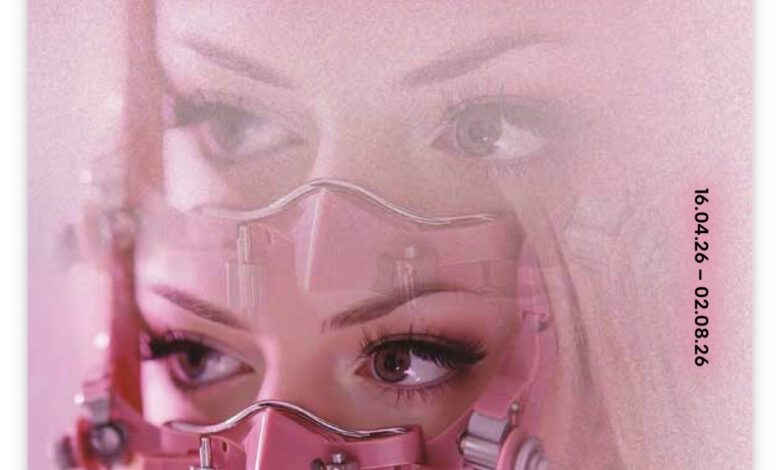
The recent opening of Soft Bodies, Cold Machines at “arebyte” Digital Art Centre in Camden, by emerging artist Ambie Drew, feels less like a conventional exhibition and more like stepping into a quietly unsettling memory, one that is both hers and, in fragments, mine and my daughter’s.
Growing up in communist Poland, my relationship with femininity was shaped by absence rather than excess. I got my first lipstick at nineteen. I had not seen a women’s magazine until I was twenty. There was no barrage of idealised images, no algorithmic whisper telling me what to desire, how to look, or who to become. If anything, the visual language of femininity in Eastern Europe was scarce, muted, barely there. Fast forward a few decades, and the contrast is dizzying. Today’s young women are raised not in scarcity, but in a relentless overflow of hyper-feminised imagery, not just curated, but amplified and weaponised by algorithms.
This shift is not abstract to me; it is deeply personal. As a mother of a daughter, I tried, sometimes stubbornly, sometimes naively, to resist it. When my daughter was born, in 2000, I made a quiet pledge: no pink in her bedroom. I wanted to create a space unburdened by coded expectations. But it was, in many ways, a losing battle. By 2009, as she entered her early digital life, she got bombarded by Facebook’s advertising machinery and its rapacious expansion. The digital world closed in quickly on my daughter, persistently, but at first, invisibly to me as a parent. Pink was no longer a colour; it was a system.
My daughter is twenty-six now, a feisty DJ Dilly in New York, resilient and self-defined, despite having gone through what I can only describe as the washing machine of digital media overload. Watching her grow up online has been both awe-inspiring and anxiety-inducing, a real rollercoaster of parental hopes and fears. It is this tension between agency and influence, performance and authenticity, that Ambie Drew digital artwork captures with remarkable sensitivity.
Ambie, born in 1996, belongs to a generation that has never known a world without the internet. Her birth comes just two years after we opened Cyberia in London, the world’s first Internet Café, a time when the web was largely shaped by male voices, with rare and radical exceptions like early female digital artists who carved out experimental spaces online. Early Internet artist Olia Lialina explored intimate war and love tangles using very early HTML.
For her, the Internet was a witness, not a source of manipulating messaging.
Other artists like Jodi duo explored glitches and digital subversions. Another female artist, from Bay area, Lynn Hershman Leeson, explored digital impact of manipulation in her alter ego Lorna, agoraphobic woman who is stuck indoors while Internet visitors can manipulate her behaviour and control her via digital interface. Lynn’s work embraced physical and virtual realms, examining identity and interactive media via digital personas.
That history lingers quietly in the background of Ambie’s work. But things have changed by the time Ambie showed up. What does it mean to grow up not just alongside the Internet, as Olia and Lynn did, but inside it? What does “girlhood” look like when it is intimately mediated, endlessly mirrored, and constantly watched?
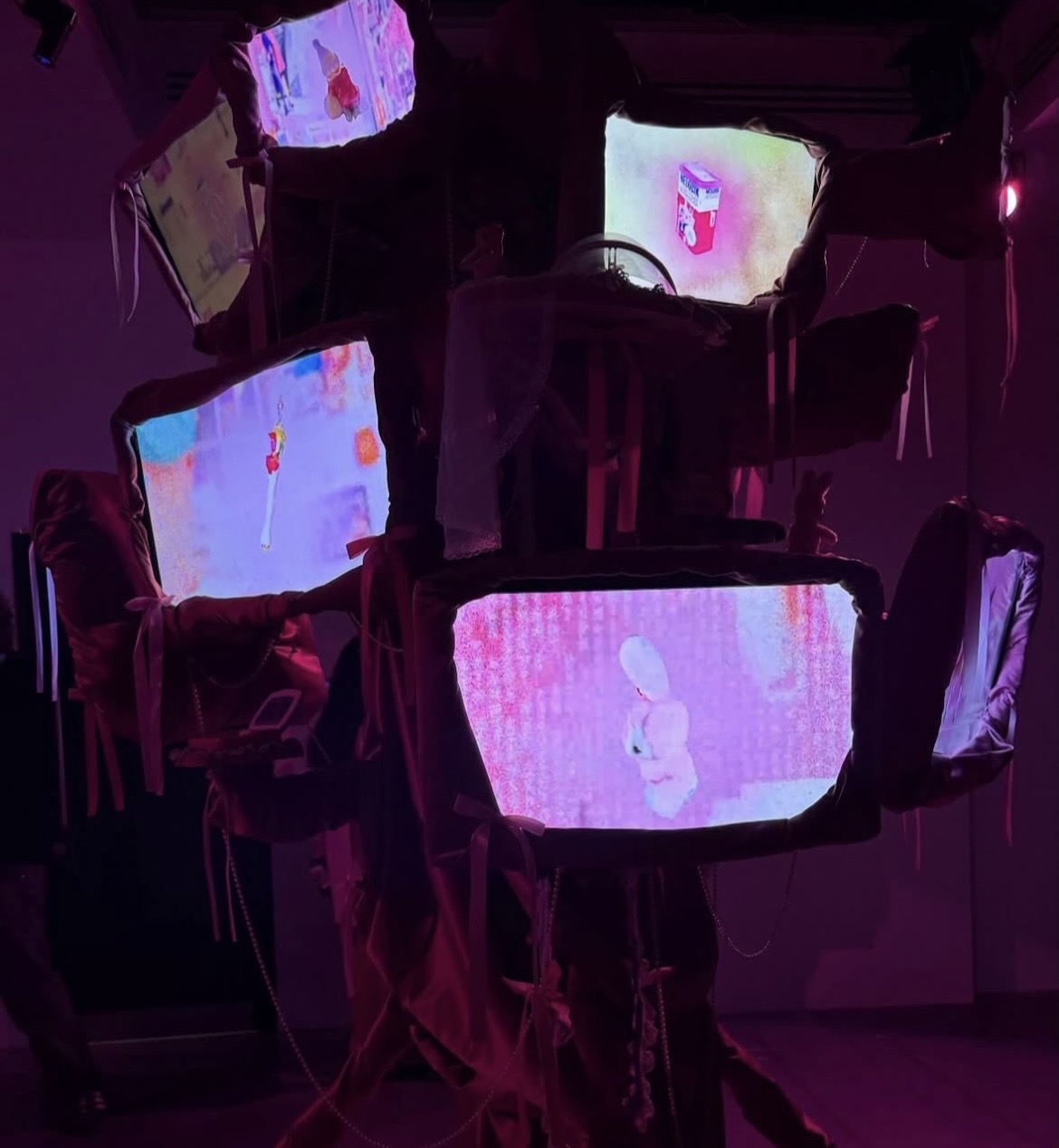
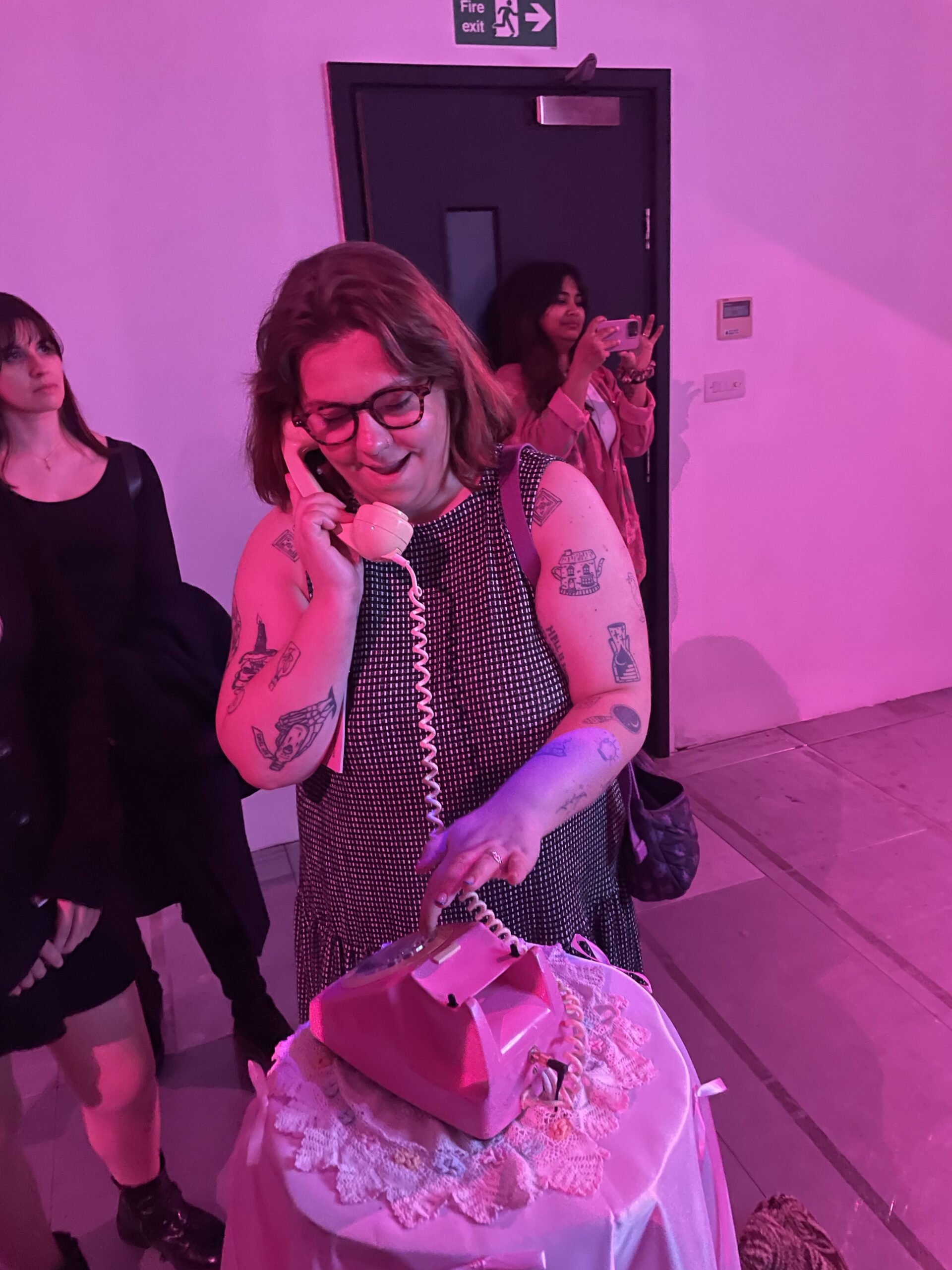
In Soft Bodies, Cold Machines, Ambie invites us into an intimate, disarmingly personal environment. We find ourselves in her bedroom, a site of both vulnerability and construction. There is an analogue pink, old style telephone, a tactile relic that feels both nostalgic and performative. A hyper-cute beauty table gleams with exaggerated femininity. A digital mirror reflects not just the viewer, but a version of the self that feels algorithmically enhanced and forever out of reach.
 And yet, nothing here is entirely stable. We are never quite sure: is this autobiography, or are we navigating an avatar? Is Ambie present, or are we interacting with a carefully constructed digital persona? This ambiguity is central to the work. The blending of Ambie’s archive and her digital identity, cyber-avatar creates a ghostly familiarity, with a sense that we are witnessing something deeply real, even as it slips through our grasp.
What emerges is a quiet but persistent question: what does the Internet want from us, as women? More specifically, what does it want from young girls?
The title itself, “Soft Bodies, Cold Machines”, suggests passivity, a dystopian imbalance where human vulnerability meets technological indifference. But Ambie refuses to remain in that register for long. Instead, she begins to probe the system for cracks. Glitches appear with moments where the hyperfeminine aesthetic becomes exaggerated to the point of instability, where cuteness tips into something more powerful, dark and quietly subversive. Girl cyber-noir?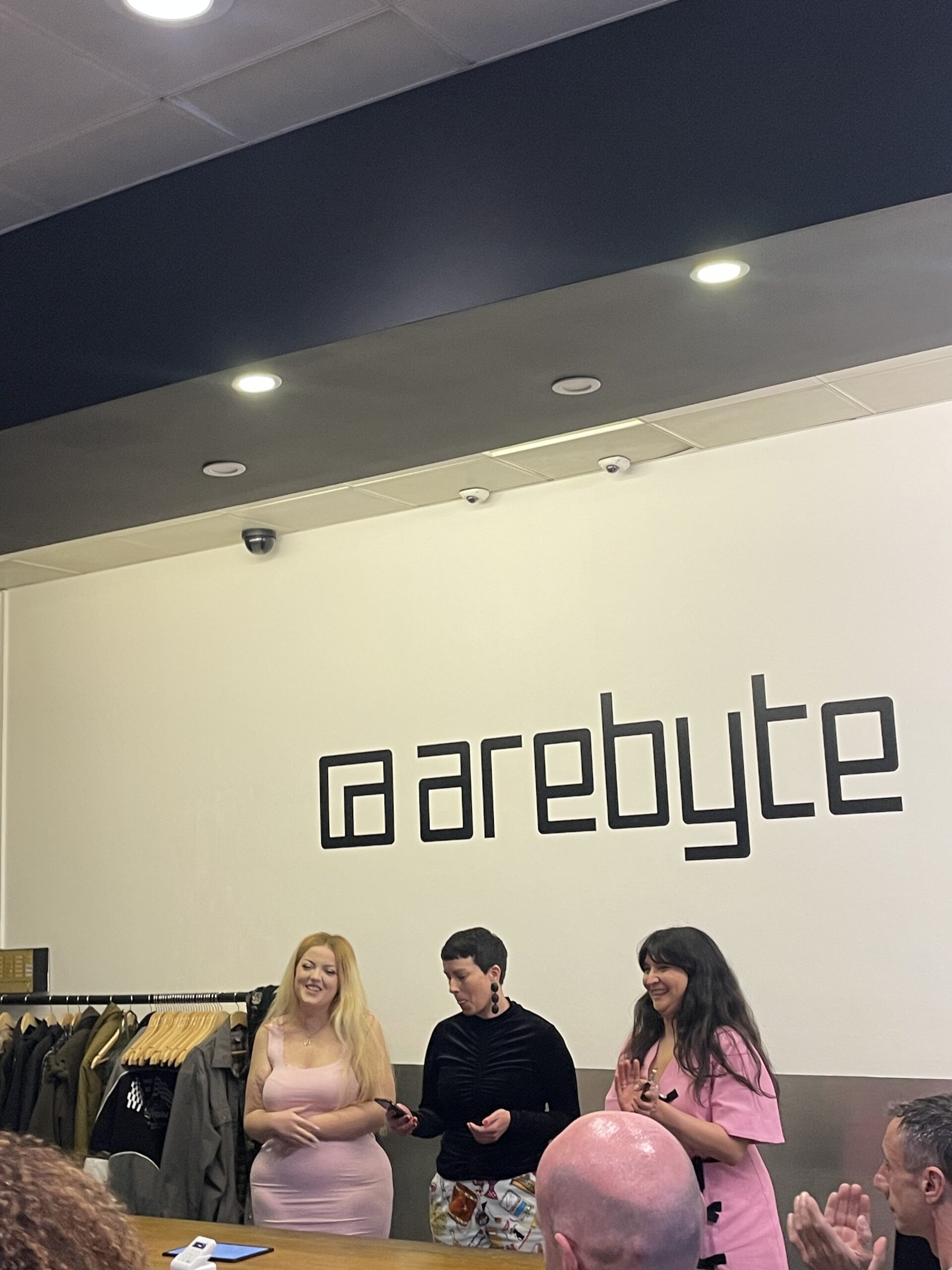
This is where her work resonates with a lineage of female digital artists who have interrogated online identity, intimacy, and control. There is a shared impulse to expose the mechanics behind the image, to question the boundaries imposed by platforms, and to reclaim female agency within systems designed to shape their behaviour.
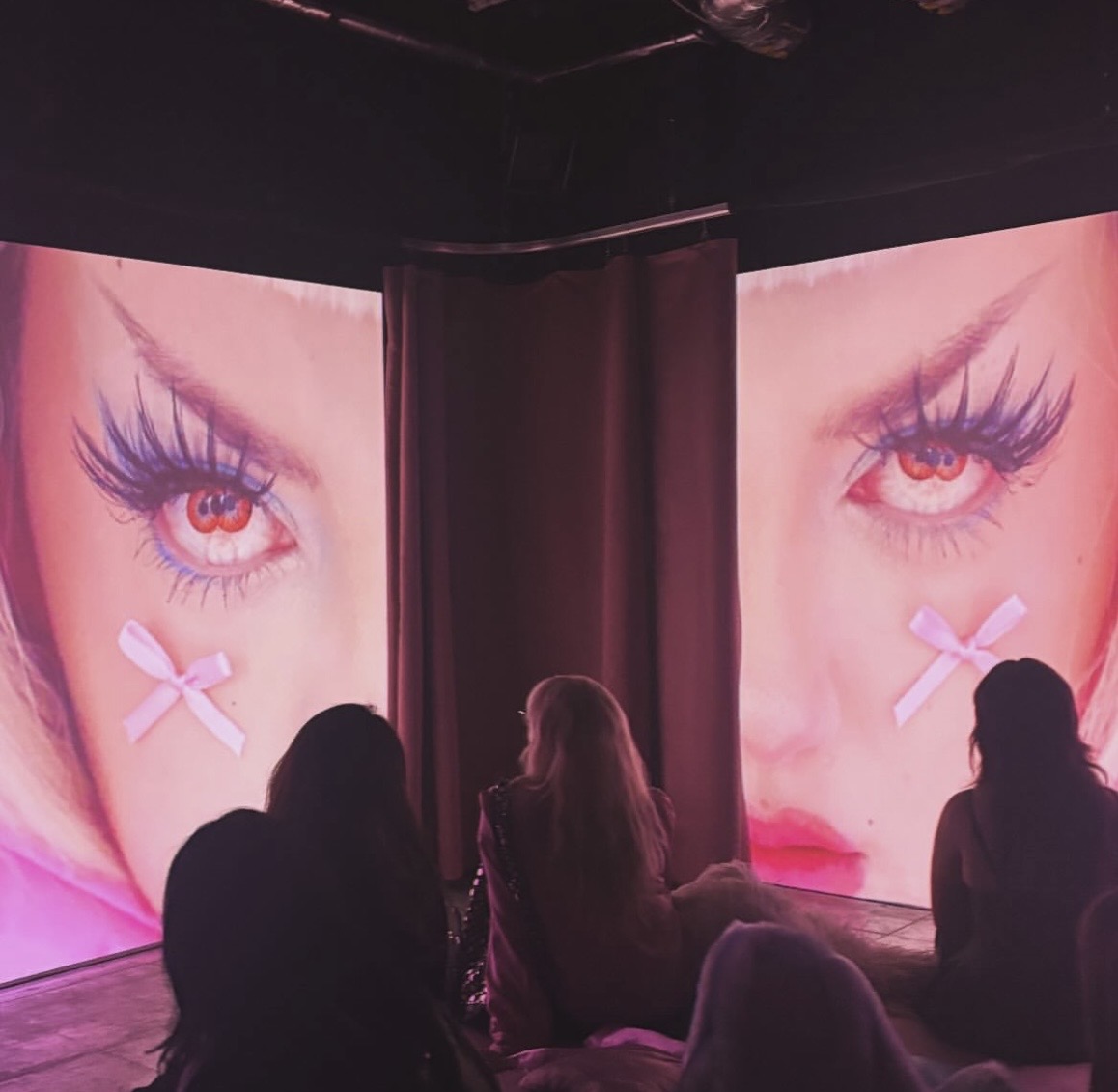
One of the most striking elements of the exhibition is a double-screen video installation that reflects on the boundaries of AI-generated hyper-femininity. Here, the polished, idealised outputs of generative systems are set against the messy, often censored realities of being a young girl online. The contrast is stark and unsettling. The “perfect” digital girl is infinitely reproducible, endlessly compliant. The real girl is fragmented, negotiated and frequently suppressed.
This tension speaks to a broader condition: growing up online in a kind of panopticon. Surveillance is constant, but so is digital creators’ performance. The gaze is not singular, it is distributed across platforms, audiences, and algorithms. Layered onto this is the presence of the manosphere, with its own set of expectations and pressures. And yet, paradoxically, there is also power in Ambie’s space. The aesthetics of pink cuteness, often dismissed as trivial, can become tools of self-expression, even resistance.
Ambie does not offer easy answers. Instead, her work oscillates between fascination and critique, immersion and withdrawal. There is a palpable sense of longing, for connection, for authenticity, perhaps for escape. A quiet cry for cutting the digital cord runs through the exhibition, though it is never framed as a simple solution.
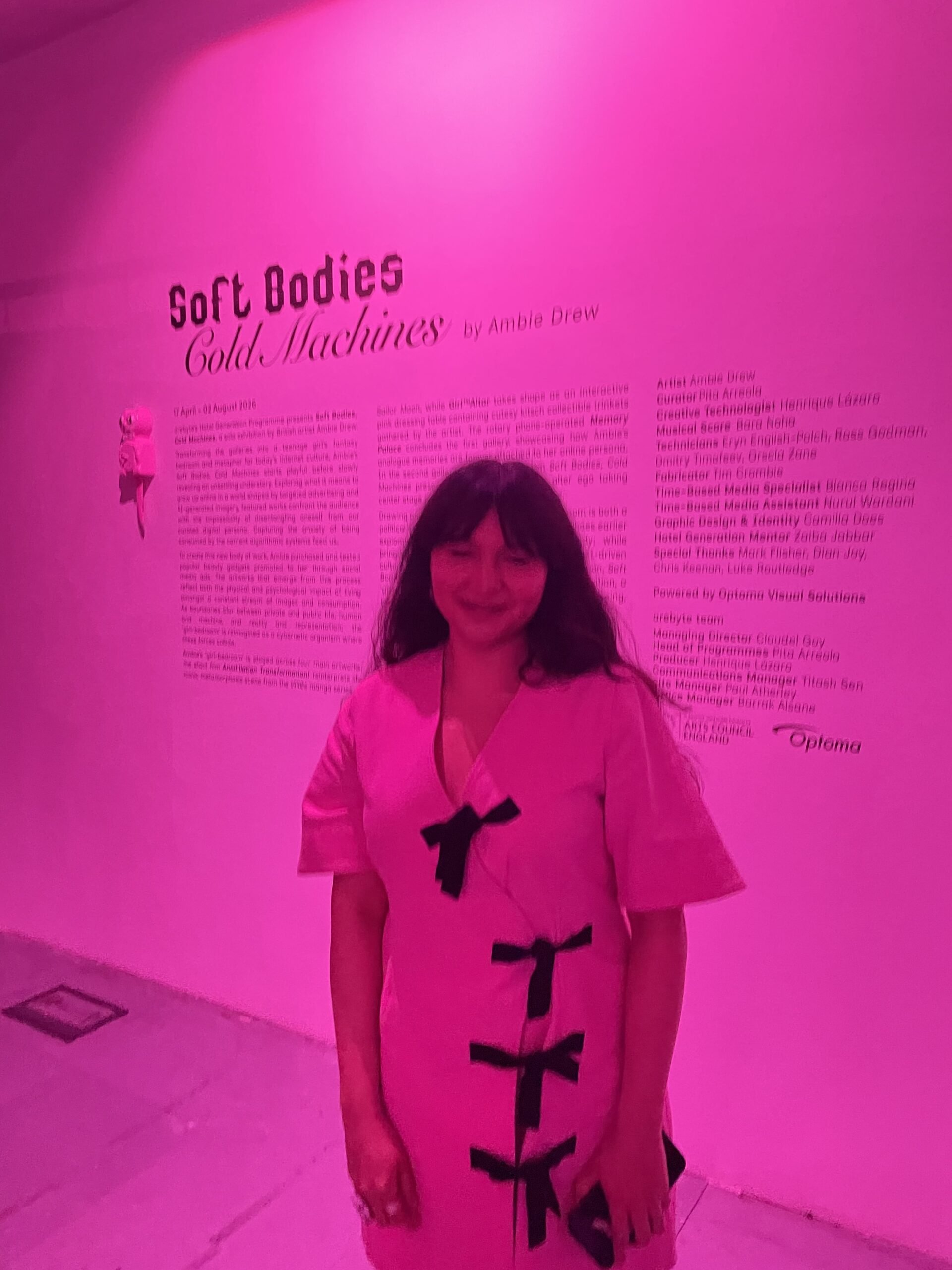 What makes Soft Bodies, Cold Machines so affecting is its refusal to moralise. It does not position the digital world as purely harmful, nor does it celebrate it uncritically. Instead, it inhabits the complexity of lived experience, particularly the experience of young women navigating identity in an environment that is both enabling and extractive.
For someone like me, whose formative years were defined by Internet as a tool for connection, not isolation, with femininity absent rather than in excess, this work offers a way of understanding a radically different kind of upbringing. It bridges generations, not by smoothing over differences, but by holding them in tension.
Leaving “arebyte” Gallery and the exhibition, I am left with a lingering question, not just about Ambie’s AI-mediated world, but about my daughter’s, and perhaps even my own: how do we remain soft, human, and self-defined in the presence of algorithmic machines that are anything but?
Curated by Pita Arreola. Music by Bara Noha. Creative technologies Henrique Lazaro. With thanks to Zaiba Jabbar, Ambie’s mentor, Hotel Generation Judges of the Competition for young Digital Artists, Dian Joy, Arts Council England and many people who supported Ambie, ‘arebyte’ Digital Art Centre team.
The exhibition is open untill 2nd August 2026.
