What the Victorians can teach us about AI?
Wikipedia and Women of The Great Exhibition
175 years ago, the Great Exhibition of 1851, was created by the Royal Society of Arts. It wasn’t just a showcase of shiny world-class inventions; it was a masterclass in helping society navigate massive technological change.
Victorians were facing their own “AI moment”:
*moving from horse travel to trains, with nearly a million jobs lost from farriers, saddlers, innkeepers and grooms
*from muscle power to hydraulic machinery, from rural life to industrial factories
* and learning (sometimes the hard way) how to make new industrial workplaces safer
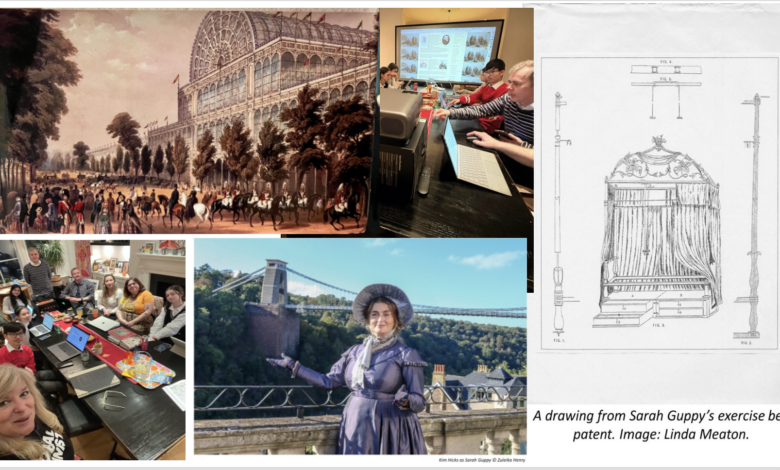
Instead of resisting change, they created an experience. The Crystal Palace building constructed originally in Hyde Park, brought the world’s innovations together, helping 6 million people see, understand, and try new technologies. It turned disruption into curiosity.
Fast forward to today – we had the chance to explore a Virtual Reality version of the Great Exhibition (beautifully developed by Keith Wood) at the RSA in London, and it felt surprisingly relevant. A digital stroll through Victorian innovation history that sparks very modern questions.
One discovery that stood out: women were far more present than the official catalogues suggest. That led us to a Wikipedia editathon (marking Women’s History Month), where, supported by Wikimedia senior editors, we started building and improving records of women inventors who contributed, but were often missed off Exhibition’s official records.
A few favourites:
– Sarah Guppy – engineer, chain link bridge inventor, mentor to Brunel, and creator of a bed designed to encourage morning exercise (Queen Victoria was very intrigued and made a note in her diary, perhaps with Prince Albert in mind!)
-Susan Durant – a pioneering sculptor and advocate for women’s education in engineering and professions
-Roxy Ann Caplin – invented a corset for women that improved posture, later patenting many health and safety devices, nominated for her inventions to join as a Fellow of Royal Society of Arts
-The Morris sisters – American botanists and illustrators contributing to early understanding of plant evolution
And let’s not forget: the Exhibition itself funded future knowledge and creative hubs like the Natural History Museum, the V&A, and the Royal Albert Hall. It wasn’t just about displaying hot innovation changing work and daily life, it invested in learning ecosystems that we still enjoy.
From Sleep-Tech and smart beds to new work machines and wellness, the show proved that new technology has lots to offer. It also fostered a new US-British industrial collaboration, with both sides benefiting from knowledge exchange, leading to the first U.S. World’s Fair in 1876 in Pennsylvania.
So here’s the question for us:
+ What’s our modern “Crystal Palace” for AI?
How do we:
- make fast-moving technology like AI more accessible (not intimidating)?
- bring diverse contributors into the spotlight, not just California’s tech bros?
- turn disruption into creativity and opportunity for young graduates?
The Victorians didn’t have all the answers, but they knew this: when change is inevitable, make it visible, shared, and human.
Curious to hear, what would you build to help society navigate the AI revolution?
Thanks to RSA Stephen Oram, RSA Young Fellows Renee Lei and Jiun Tan, Karolina Janicka, Valentyna Senatovych and Sophia from Middlesex University, Ben Greenaway (The Fold), Rafa Azevedo (ChainAcademy) and Wikimedia’s Lucy Crompton-Reid FRSA, senior editor Ed Hands, grateful for all your support
Refs:
VR of the 1851 Great Exhibition http://www.hookedwit.uk
https://en.wikipedia.org/wiki/Wikipedia:Great_Exhibition_editathon
Books : “World for a Shilling” by Michael Leapman
“The Great Exhibitor – The Life and Work of Henry Cole” by Elizabeth Bonython and Anthony Burton