Chornobyl at 40, A Sacred Memorial or a Living Laboratory?
To heal or to conserve? Post nuclear disaster futures
Chornobyl at 40: A Sacred Memorial or a Living Laboratory?
When your Geiger counter suddenly increases its count rate, you know something is very wrong. That is what we noted in Warsaw on the morning of the 28th of April 1986. There was no word from the authorities about what the issue could be, but just in case, we decided to hide in the basement of our students’ apartments.
World’s worst nuclear disaster in Chornobyl took place on 26th of April, but the radioactive cloud drifted for a couple of days to reach central Poland. On 28th April, our scientists detected a radioactivity level 550,000 times higher than normal. Russian authorities did not acknowledge the disaster till evening of 28th April, stealing three precious days, when we could have dispensed Lugol’s iodine tablets to affected Ukrainian, Polish and Scottish populations, all who found themselves on the path of the radioactive cloud containing a heavy dose of Caesium 137 and Iodine 131.
Due to the wind pattern, London, by sheer luck, avoided being affected, but Bangor, Glasgow and Manchester got a heavy dose of the radioactive cloud.
Chornobyl’s future fate is deeply personal to me and millions of us who were affected. I ended up with a lifelong thyroid illness, but at least we survived. Others were not so lucky. How do we commemorate their memories? How do we educate our young people about global disasters and lessons learned?
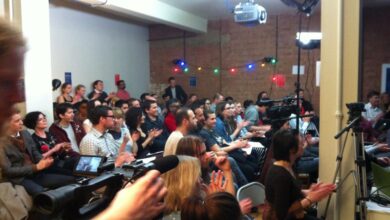
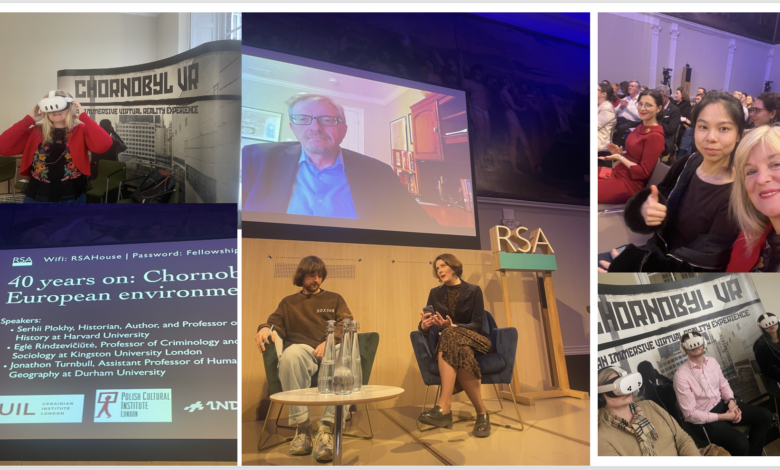
As we approach the 40th anniversary of the Chornobyl disaster, the debate over its ‘legacy’ has shifted from the biological to the philosophical. At a recent landmark RSA panel in London, prominent voices, including Dr Sasha Dovzhyk, Head of Index (Ukrainian Institute) and renowned historian Professor Sergii Plokhy, debated a fundamental question: what do we do with a scar that refused to heal?
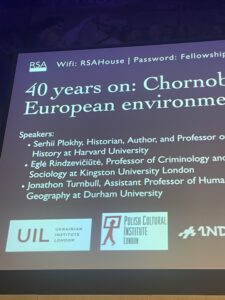
A few options were discussed, but three distinct visions emerged from this and other RSA debates, highlighting divergent paths for the future of the Zone.
The most likely is a concept modelled on “Auschwitz”:
Proponents of this view argue that the Zone should be preserved as a static, educational monument to human hubris (and tragic design failures of this specific RBMK nuclear power station, poorly converted from a military application). It would serve as a ‘dark tourism’ site that must prioritise education and respect for the deceased and for the displaced.
Another model is to follow reintegration with nature:
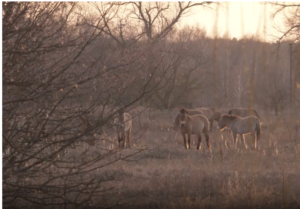
Ecologists point to the thriving wildlife, including grey wolves, Lynx, brown bears and even wild Przewalski horses that have reclaimed the concrete ruins. Black storks and Eagle Owls have been spotted nesting in the balconies of the abandoned Pripyat apartment blocks. In the absence of humans, the Chornobyl site has become, strangely enough, the safest place in Europe for the animals to exist. One of the speakers, Jonathan Turnbull, made a movie recording hundreds of dogs, currently living in Chornobyl.
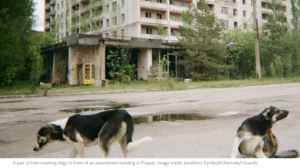
Younger generations advocate for a ‘rewilding’ approach, where the Zone becomes a massive carbon sink and a testament to nature’s resilience in the absence of man.
The third emerging option is The Living Museum and Reconstruction:
Modernists argue that parts of the Zone should be repurposed for green energy, such as giant solar farm, and reintegrated into Ukraine’s future economic life, rather than being left as a decaying tomb.
However, we still have outstanding problems, one of which is 1.5 billion euros in size.
In the early hours of February 14th, 2025, a Russian kamikaze drone, Shahed-136, managed to strike and significantly damage the New Safe Confinement (NSC), including its original 1.5 billion euros steel arch designed to last 100 years. The strike punctured the shield, threatening the ventilation systems and risking structural corrosion. Experts warn that the escalating repair needs mean that a new EU budget must be mobilised to stabilise the Zone. Personally, I would send the bill to Russians or the Iranians who made the drone (‘Shahed’ means ‘witness’ in the Persian language), but that may not be an option.
To raise awareness of the legacy of the Zone, the European Bank has funded a new Virtual Reality experience of the Chornobyl current and past set-up, including the drone strike.
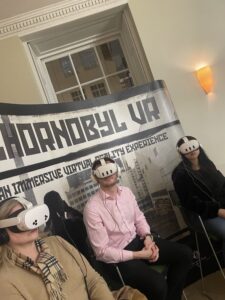
The VR has proved very popular with our Fellows at the RSA event and many Young Fellows, visiting teachers, Ukrainian and Polish friends were deeply moved experiencing the drama or reliving it in VR again.
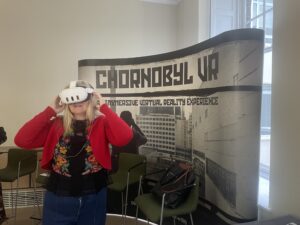
It certainly was deeply emotional for me, as my life has completely changed trajectory after the Chornobyl disaster. I pivoted from my Linguistics degree in Warsaw to developing new Interface Design for risk management of Nuclear Power Stations at Birkbeck College in London.
Ukraine still relies on nuclear power today. Over 60% of its electricity comes from a newer and more safety oriented design, VVER . It’s nine nuclear plants that have proven remarkably resilient, even under the stress of war. To secure Europe’s green energy future, it is important to remember that the Chornobyl disaster was a site-specific station design flaw, not an inherent trait of nuclear physics.
Moving Forward
What is to be done? Should Chornobyl be a graveyard, a forest or a green energy power hub? Perhaps it must be all three. As one of the speakers noted, the site is a mirror of our current world, a place where the trauma of the past meets the ecological hopes of the future, all while under the literal threat of modern warfare.
One thing is clear to me – we absolutely cannot look away. How do you think we should balance the need for memorialising tragedy with the future need to use the land for local people for energy or nature conservation?
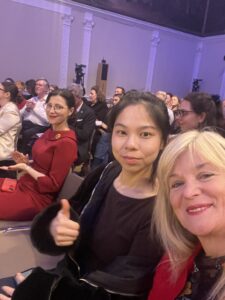
Speakers:
Serhii Plokhy, Professor of History at Harvard University
Dr Sasha Dovzhyk, Ukrainian Institute and Index
Egle Rindzevijciute, Professor of Criminology, Kingston University London
Jonathan Turnbull, Assistant Professor of Geography at Durham University
Polish Cultural Institute – POSK
Ukrainian Institute (London)
Other writings about the Chornobyl Disaster
*Eva’s witness notes from 1986
https://cybersalon.org/three-lockdowns-and-a-case-of-home-brew-vodka/
Science Focus – Nature reclaims Chornobyl
https://www.sciencefocus.com/nature/5-seriously-strange-wildlife-chernobyl
Dogs of Chornobyl by Dr Jonathan Turnbull
https://preview.shorthand.com/wscAlsVfr82plkvq
https://preview.shorthand.com/wscAlsVfr82plkvq