
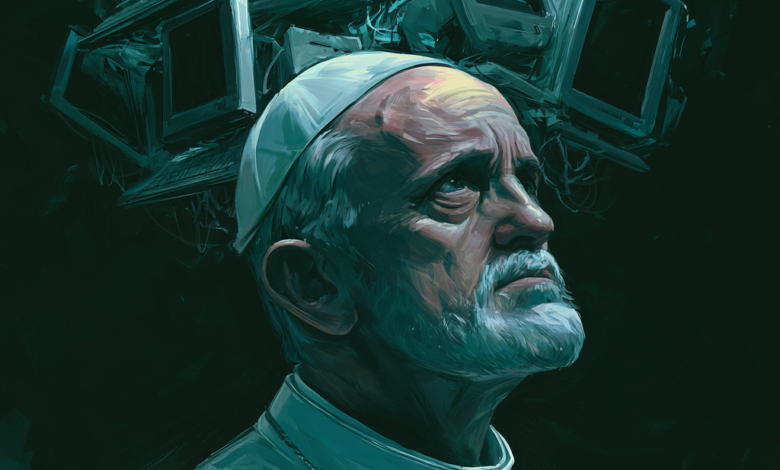
Vort3x, published on the 15th of each month, aims to pick out significant developments in the intersection of computers, freedom, privacy, and security for friends near and far. The views expressed in these stories do not necessarily reflect those of Cybersalon, either individually or collectively.
Prepared by Wendy M. Grossman.
Contents: Cybersalon events | News | Features | Diary
Cybersalon Events
AI in Campaigns at Newspeak House 16th July (East London)
9am start for a full day conference convening the people building, deploying and funding the most interesting applications of AI in Campaigning today.
From Persuasion Bots to Synthetic Focus Groups, join for a session of building and ethical critique.
“Soft Bodies, Cold Machines” – Generative AI and new Girlhood
Digital Art Show arebyte Gallery, Digital Art Center, Camden (London)
Open Wedn-Sunday 12-6pm till 2nd August 2026
Ambie Drew’s new show exploring digitally mediated ‘girlhood’ and impact of algorithmic feeds on becoming a woman.
NEWS
Improving Wikipedia: We are excited to report that Cybersalon.org is supporting PHAWM AI Consortium (Glasgow University, Kings College London) and issuing a new tool for verifying references on Wikipedia. ProVe is live and now available for testing so if you edit, please install and let us know what you think about its ability to improve referencing for your articles. Workshops on ProVe in Sept (date tbc)
UK Demands Phones Block Children From Taking Nude Photos
———————————————————————-
In a speech at London Tech Week, UK prime minister Keir Starmer has told Google and Apple to modify their software to prevent children from taking, sending, or viewing nude images on their phones within three months, Rajeev Syal reports at the Guardian. Starmer went on to say he will pursue legislation if the companies don’t comply. At the BBC, the resignation letter submitted by Jess Phillips, who was minister for safeguarding, names the failure to enact this policy among her reasons. In a statement in response, Signal says that the proposal will endanger everyone, strengthen the market dominance of Apple, Google, and Microsoft, and endanger everyone while failing to protect children.
Neal Stephenson Contemplates the Death of the Metaverse
——————————————————————–
In this Substack posting, Neal Stephenson, who coined the term “metaverse” (built on existing previous real technology experiments) in his novel Snowcrash, ponders Meta’s announcement that it has killed its metaverse project after spending $80 billion. Stephenson goes on to discuss the difference between fictional and engineered virtual worlds and offers sage advice to those betting their companies on headsets.
Comment: We run two Virtual Worlds, digital twins of the original Internet Cafes Cyberia (London and Paris version). Both were initially on Altaverse, then on Spatial. It is time to move again, most likely to VRChat. More to come but all our spaces are alive and continuously hosting new digital art events. Digital Twins in VR will live post Metaverse.
AI Boom Fuels “Anti-Tech Extremism”
———————————————————————-
The AI boom is becoming a driver of political violence and anti-tech extremism, Nick Robins-Early reports at the Guardian, quoting researchers, who blame closing off legitimate avenues for expressing public opposition. At Wired, Daniel Boguslaw reports that leaked documents show that the FBI and other domestic law enforcement agencies are beginning to surveil “anti-tech extremists” as an emerging threat. At The Intercept, Matt Sledge and Sam Biddle have seen documents from law enforcement that show a Philadelphia-area fusion center conclude from social media posts that there is a growing risk of physical violence form “domestic violent extremists” obtained by Wired and The Intercept. At 404 Media.
Comment: The attack on OpenAI CEO Sam Altman’s house, among the series of other incidents Robins-Early lists, are focusing law enforcement attention, but these revelations suggest they are failing to distinguish between violence and legitimate, peaceful protest.
Munich Court Rules Google Is Liable for AI Overviews
———————————————————————-
The Munich regional court has ruled that Google’s AI Overviews are the company’s own content and therefore it is liable for their errors, Matthias Bastian reports at The Decoder. The ruling distinguishes between search engine results, which index others’ content and which courts have exempted from liability, and AI Overviews, which Google’s systems generate themselves and rejects Google’s contention that users can check for themselves, given that sources are typically missing. Bastian notes that the ruling could apply to every AI provider who paraphrases material scraped from the web. At Ars Technica, Jon Brodkin reports that the UK’s Competition and Markets Authority has ordered Google to put clearer attributions and links to publishers’ sites in their AI overviews. The CMA has given Google nine months to comply, bars the company from penalizing publishers for opting out, and says the move should put publishers in a stronger negotiating position.
Comment: The Munich decision – which Google will presumably appeal – has the potential to change the landscape for liability for scrapers.
Sam Altman Beats Elon Musk in Court
———————————————————————-
The jury in Elon Musk’s lawsuit against OpenAI and Sam Altman has ruled against Elon on the basis that he took too long to file his case, David Ingram reports at NBC News. The lawsuit claimed that Altman had unlawfully enriched himself from OpenAI, which Musk and Altman co-founded as a non-profit. OpenAI created a for-profit arm in 2019 after two years of discussion, and Musk began building his own competing xAI startup in 2023.
US University Graduates Boo AI Boosters
———————————————————————
American university graduates are booing commencement speakers who promote AI, Heather Hollingsworth and Jocelyn Gecker report at APNews. Among those booed are former Google CEO Eric Schmidt, music executive Scott Borchetta, and Adobe AI evangelist Chris Duffey. The graduating students seem primarily motivated by the feared impact of AI on jobs and the economy, some calling the speeches “tone-deaf”.
Comment: The article doesn’t mention climate change as a motivator, but it’s a safe bet that many young people are also worried about the environmental impact and energy and water consumption of data centers.
FEATURES & ANALYSIS
Pope Leo XIV Issues Encyclical on AI
————————————————————–
At the Vatican website, Pope Leo XIV has published the encyclical “Magnifica Humanitas: On Safeguarding the Human Person in the Time of Artificial Intelligence”, which calls for respecting human values and “disarming” AI. At The Atlantic, science fiction writer Ted Chiang warns against conflating the linguistic fluency of generative AI with consciousness. No matter what they say, large language models remain machines. At 404 Media, Samantha Cole reports on a new study that identifies 37 dark patterns in AI chatbot design that encourage anthropomorphism, over-sharing, and lead to user harm. At a website set up for the purpose, more than 2,000 mathematicians have signed the Leiden Declaration calling for action to protect the future of mathematics as a discipline in the fact of AI tool use.
Comment: All of these have the same message: embrace humanity, control the machines.
AI Struggles to Find Return on Investment
————————————————————–
In this article at the Financial Times, Joachim Klement invokes the dot-com term “irrational exuberance” to describe the current AI boom, concluding that the amount of money being spent by hyperscalers and others does not make mathematical sense compared to the revenues that would be needed to make it worth the investment. At the Wall Street Journal, Christopher Mims explores a warning from Mario Zechner and Armin Ronacher, the two engineers who built the agentic part of OpenClaw, about “vibe slop”. The rush to replace junior engineers with AI creates buggier software, security vulnerabilities, and a lost pipeline to developing senior engineers. Vibe coding, they say, is better at generating new code than assessing and maintenance the massive code bases common to older and larger companies. At The Register, Dan Robinson reports that new research from Gartner found that the 80% of 350 billion-dollar-plus businesses it surveyed had cut staff in favor of AI generally failed to make a return on that investment. Even so, Gartner expects spending on agentic AI to continue to rise.
Rising Token costs focus the minds of managers
———————————————————————-
In this article at Fortune, Jake Angelo examines Microsoft reports to find that using AI is costing the company more than human employees and is scaling back AI use. At Business Insider, Brent D. Griffiths reports that for cost reasons Amazon has shut down its token leadership, which pushed its employees to “tokenmaxx”. At Tom’s Hardware, Stephen Warwick reports that an unnamed company spent $500 million in a single month on Claude by accident because it failed to set usage limits. Finally, at TechCrunch Lucas Ropek reports that developers on Github are pushing back against the June 1 change to usage-based pricing for Copilot, which has sent their costs soaring.
Comment: Companies have been subsidizing AI use by offering either very low prices or free access. As some – notably OpenAI and Anthropic – push to go public, raising revenues is urgent. It is unclear if people will be willing to pay real market prices.
Google Hack Eliminates AI Overviews
——————————————————————–
In this blog posting at Tedium, Ernie Smith reups his workaround hack that eliminates Google’s AI overviews from its search results, which he has implemented as a website. Since he built it in 2024 while sitting in a restaurant, the site has frequently gone viral. The code he used is one of a number of obscure Google codes that Terry Tan unearths at SerpApi.
Comment: Or, of course, use a different search engine that doesn’t force AI on you.
DIARY
—————————————-
June 25-28, 2026
Montréal, Quebec, Canada
A computer science conference with a cross-disciplinary focus that brings together researchers and practitioners interested in fairness, accountability, and transparency in socio-technical systems.
—————————————-
August 6-9, 2026
Las Vegas, Nevada, USA
DEF CON is one of the oldest continuously running hacker conventions around, and also one of the largest.
—————————————-
August 6-9, 2026
Vancouver, BC, Canada
A Canadian conference for decentralized social networks and the social web.
—————————————-
August 14-16, 2026
New York, NY, USA
HOPE 26 will be the seventeenth Hackers On Planet Earth event. This promises to be a memorable event. It is open to all hackers, makers, tinkerers, experimenters, artists, educators and anyone else with an interest in exploring and improving the world we live in, and sharing knowledge with others. HOPE is an all-ages event with multiple simultaneous sessions and many other things to do throughout the weekend.
—————————————-
August 28-30, 2026
Paris, France
State of the Map is the annual event for all mappers and OpenStreetMap users. In 2026 the State of the Map conference will be taking place in Paris and online. It will be a three day conference packed with talks, workshops, discussion rounds and more.
—————————————-
October 6-7, 2026
Online
Most of FediForum will be an unconference. That means that you, the attendee, will help determine what subjects are discussed. So bring your session ideas! You can mention some during registration, but you can change your mind until the very morning of FediForum when we together make the agenda. We will also again see speed demos of cool Open Social Web software using open protocols such as ActivityPub and ATProtocol.
—————————————-
October 28-30, 2026
Barcelona, Spain
Mozilla Festival, aka MozFest, is three days of bold conversations, hands-on building, and ideas worth traveling for. This year’s event is partnering with the City of Barcelona and taking part in Open Tech Week — a city-wide celebration of the people shaping a better digital world.
—————————————-
November 4-6, 2026
Washington, DC, USA
The Privacy + Security Forum brings together the most seasoned thought leaders in the areas of privacy and security law for rigorous deep-dive sessions that deliver hands-on activities and practical takeaways for conference participants.
—————————————-
November 9-12, 2026
Lisbon, Portugal
Web Summit runs the world’s largest technology events, connecting people and ideas that change the world. Web Summit’s mission has been to create software that enables meaningful connections between the CEOs, founders, investors, media, politicians and cultural figureheads who are reshaping the world
—————————————-
November 13-14, 2026
Bolzano, Italy
The South Tyrol Free Software Conference, SFSCON, is one of Europe’s most established annual conferences on Free Software. SFSCON promotes the use of Free Software in digital infrastructures as a tool to achieve greater innovation and competitiveness. Here decision-makers and developers meet, learn and get inspired.
—————————————-
December 14-18, 2026
Nairobi, Kenya
The 21st annual meeting of the Internet Governance Forum, which serves to bring people together from various stakeholder groups in discussions on digital public policy, is expected to draw more htan 9,000 participants from 165 countries to contribute their perspectives on the most pressing issues, priorities, and challenges in the governance of digital technologies.
—————————————-
December 27-30, 2026
Hamburg, Germany
Over the last 40 years, the Chaos Communication Congress has become a Europe-wide renowned event with more than 17,000 participants annually, drawing an ever-growing group of international guests.
—————————————-
February 9-10, 2027
London, UK
The 2027 State of Open Con will focus on Open Technology including open source software, open hardware, open data, open innovation, open standards, and the value that the open community brings to the UK and its digital economy. Alongside a diverse range of topics, the event promises to include a diverse range of speakers and participants.
