Reclaim public space: From Poland’s Solidarity protest to Mexico City pink glitch art
Notes from V&A panel with Julieta Gil and Pita Arreola (arebyte Gallery) 5/9/2026
From Poland’s Solidarity gnomes to Mexican Radical Fragility
By Digital Art & Activism Desk @evapascoe
Monuments are strange things. One day you just pass them by, rushing to work on your morning commute, oblivious that they are even there. The next, they morph into symbols of oppression, so you throw paint at them, splash graffiti protest slogans and fight with police over access. Your quiet square becomes a battleground over who owns history.
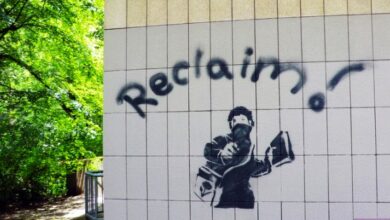
Back in 1982, as a student in Poland, I was helping in the Solidarity anti-communist movement, painting orange garden gnomes on the walls of Wroclaw, one of the first cities of the protest. Our weapon of choice was chalk; the gnomes’ hats were bright orange. It was an oddly effective sign of resistance to the brutal communist regime, a movement invented by Waldemar “Major” Frydrych and then picked up by thousands of people across Poland. What else can you do when there were nearly 90,000 Russian troops stationed in your city?
It was very risky; you could have been arrested and thrown in jail, but police felt embarrassed tackling young students for simply drawing colourful garden gnomes in chalk on city walls and monuments. Unlike graffiti, chalk didn’t damage the buildings or monuments we targeted, and it left no permanent scar. After the rain, we just re-did it all again. The gnomes’ campaign was effective; it was a way we signalled to each other that there were more of us than “them”. This was the early days of the Solidarity revolution that eventually overturned communism in Poland in 1989.
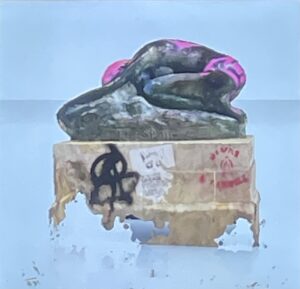
I always had a deep interest in the practice of protest, so I was excited to be invited to the V&A Museum in September to meet a young Mexican activist-turned-digital artist, Julieta Gil. She witnessed and captured in digital format large street protests in Mexico in 2020. Thousands of women disappeared and were killed in a wave of cartel crimes, later named “Mexican Femicide”. Young women were getting kidnapped on the street and never seen again. The government did nothing. Frustrated, Mexico City activists picked their pink and glitter paints and targeted the monuments of the city, covering the intimate parts of the muscular patriarchal figures with a Barbie pink dye, mixed with glitter. It was a protest against the government’s lack of action against women’s deaths and the impunity of drug cartels.
What happens when an imposing stone monument meets a splash of neon pink paint, a painted dwarf on a city wall, or a shower of micro-plastic glitter?
Spray and Douse campaign
There is a long tradition of protest using public monuments in Europe, from 1914 ink splash by the Suffragettes movement to our chalk gnomes campaign by Orange Alternative in Poland in 1982. The monuments were designed to enforce grand state narratives, project immense power, and maintain an illusion of state power permanence. Standing tall in bronze, granite, and marble, those huge sculptures were there to dictate history from above, from their monumental heights, designed to intimidate.
But as history shows us, from the British Suffragettes in 1914 to Polish anti-communists in the 1980s or the Bristol monuments debate, these public monuments and civic walls often have a weak point.
They are accessible, vulnerable, open dynamic sites of political negotiation where paint, ink, and subversion can rewrite the rules of our public spaces. You just need a bit of courage and orange chalk or… pink glitter.
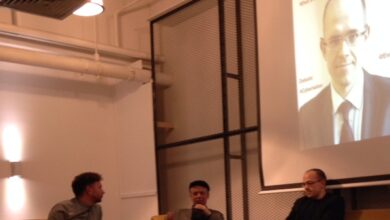
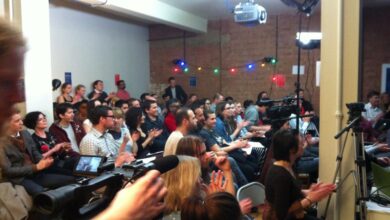
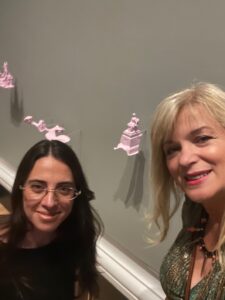
At Julieta’s talk at the Victoria and Albert Museum (V&A) in London, the artist sat down in conversation with Pita Arreola, curator at the Digital Art Center arebyte (London/Camden). Together, they explored how direct-action protests, digital archiving is transforming telemetry into 3D printing, and subverting public spaces intersect in the fight against violence against women and young people in general.
Disrupting the Material of Power – pioneering voices
The tradition of using paint, dye, or direct visual interventions on public architecture is a long-standing direct-action tactic. Gen Zs are looking for new options, after discovering that being a keyboard warrior is just a thinly diluted version of what an effective political street protest is about.
The Suffragettes (1914)
In 1914, British Suffragettes attacked Velázquez’s Rokeby Venus and poured ink and red paint over museum vitrines and public statues. Their aim was simple: break up and disrupt the impeccable facade of public heritage to demand visibility for women’s suffrage and votes and to draw attention to the physical hurt of force-fed political prisoners in British jails.
The Orange Alternative in Poland (1982)
Visual resistance took a playful, even absurd, yet deeply subversive turn in 1982 in Wrocław, Poland. As the communist regime cracked down on the Solidarity (Solidarność) movement and introduced martial law, young student activists created the Orange Alternative (Pomarańczowa Alternatywa).
The Action was led by Waldemar “Major” Fydrych, activists began painting colourful garden gnomes over the paint splatters routinely deployed by the communist militia to cover up anti-communist slogans on city walls and monuments.
The Subversion was achieved by placing playful, toy-like garden gnomes on top of state-sanctioned censorship. “Major” used irony, absurdity, and surrealism to undermine totalitarian authority. You couldn’t arrest someone for painting a fairytale gnome without making the regime look utterly ridiculous. The police tried but stepped back after their vans were also painted with orange garden gnomes. The gnomes became for us, young students, a glowing badge of support for Solidarity, demonstrating how colourful, childlike pigment and playful imagery can disarm even rigid authoritarian power.
Modern Anti-Imperialist & Anti-Racist Movements
For activists, paint never goes out of fashion. Throughout the late 20th and early 21st centuries, young activists repeatedly returned to paint as a direct response to state violence. From spraying red paint across Guernica in 1974 to pouring paint over colonial and slave-trader statues across South Africa, Europe, UK, and the U.S. during the #RhodesMustFall and Black Lives Matter movements.
Julieta Gil: From Architecture to 3D Anti-Monuments
Pita’s guest at V&M, activist and 3D artist Julieta Gil was just graduating from her architecture degree when the peak of Mexico City protests against women’s deaths erupted in March 2020. She brought an art perspective to this physical battleground. Because of her architectural education, Gil understands the precise mechanics of monumentality: the role of scale, the use of imposing materials like marble and granite, and how physical structures are engineered to humble the human body, to make the viewer feel small, insignificant and powerless.
Gil’s work directly responds to the mass disappearances and femicides occurring across Mexico, where thousands of young people women and men took to the streets demanding justice in 2020. During these six months of protests, the rebels, many of them young women, aimed at iconic structures as their canvas, such as Mexico City’s Angel of Independence. The community used them as a communication tool, like a real art canvas for activists who spray-paint messages, pour pink dye on the stone, and throw glitter.
For Gil, in her conversation with Pita, she commented that this was not vandalism. The act of pouring or painting pink swimming trunks on a monumental hero is a vital negotiation of public space by those who are refused their own space and safety. She mentioned a meeting with the art curator who looked after Angle of Independence. The curator validated the protest at the site, noting: “the most important monument is the living human body”. When living bodies are systematically violated, women are killed, and their bodies disappear, then an inanimate stone pillar must help in the right to community protest. She invited artists to photograph and to take videos of the monument, to archive and retain memory of the events.
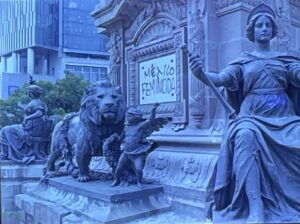
The Materiality of Glitter and Pink
For me, it was a trip down memory lane. Much like the Orange Alternative’s use of garden gnomes to subvert communist state power in Poland, Mexican activists frequently use glitter and hyper-pink pigments. These materials were typically dismissed as “girly,” passive, or toy-like.
In her interview with Pita, Julieta Gil highlighted the subversion behind this choice:
The Irony of Glitter
“While societal consensus views glitter as superficial or ephemeral girls’ play, anyone who has ever used glitter knows its true nature: you can never scrub it off clothes or monuments. It sticks, migrates into pores of stone, and persists in rain and snow”.
Glitter subverts the rigid, unyielding granite of a monument by contaminating it indefinitely. I couldn’t stop thinking that in 10,000 years, a future archaeologist will study Angel of Independence events and conclude that the Mexicans of 2020 were performing some strange fertility glitter rituals, painting intimate parts of monumental heroes in bright pink.
50 shades of Pink
By taking a shade traditionally equated with girls, with passivity and childhood toys, Mexican activists weaponised it as an act of “radical tenderness” (as described by Julieta), turning a symbol of femininity into a sharp, loud and permanent cry of resistance.
Tools of Translating Protest into the Digital Realm: 3D Photogrammetry as Archive
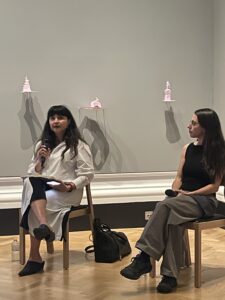
The host and digital art curator Pita Arreola brought a key tension to the conversation:
“Normally, digital art is fragile, easy to erase.”
Pita posed a question: how can we capture an ephemeral, fast-changing physical protest using a digital medium of 3D printing that is inherently susceptible to breaking and fragility?
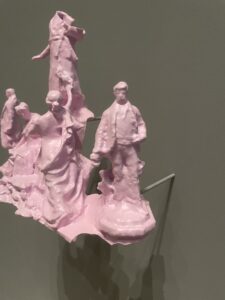
Gil’s answer lies in photogrammetry, the process of combining dozens of overlapping photos of the paint-splattered monuments to generate new 3D digital models of the monuments. By rendering these physical interventions into code and 3D-printed models, Julieta turns fleeting political actions from fragile and ephemeral into permanent digital archives.
Rather than trying to smooth out her 3D digital models to match reality, she allows the software to introduce glitches. The resulting imperfect replicas render the original imposing monument broken and fragile. Her 3D software exposes the truth: she says, “the permanent stone monument was always fragile, while the collective memory of protest becomes the real, lasting permanent structure”.
Decentralising the Archive
What I loved about Gil’s work is that it does not remain locked inside institutional walls.
Open Distribution
Gil makes her 3D files accessible to the public via QR codes on her website, enabling anyone to download, view, and redistribute these anti-monuments globally.
Institutional Recognition
Despite her relatively young age, Julieta is already an established artist, with a focus on documenting protest using new digital technologies. The V&A Museum in London acquired her digital files as well as the 3D models, legitimising digital photogrammetry as a critical tool for contemporary political preservation.
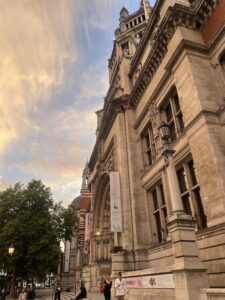
Physical Echoes
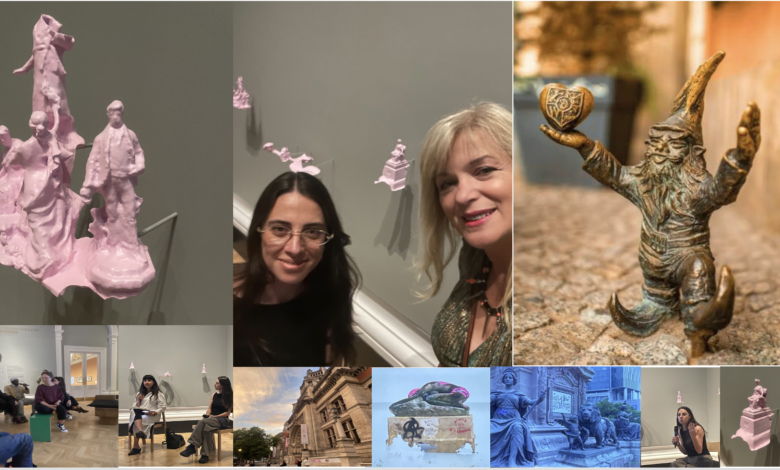
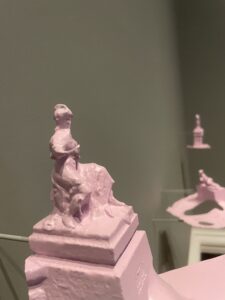
I am always interested in the material heritage: what is left after the excitement of the exhibition, after the audience leaves the building. This show has included, alongside Julieta’s digital archives, her physical prints of these 3D scans, bringing the digitally preserved, paint-stained pink miniature monuments back into gallery spaces. Those prints were exhibited in their pink, fragile and imperfect, glitchy state on the walls of Photographers’ Gallery in the V&A.
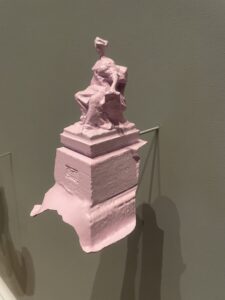
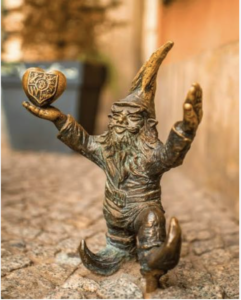
This physical artefact reminded me of what happened to our chalk garden gnomes from Solidarity times. Many years later, when the new, post-communist government in Wroclaw wanted to commemorate Orange Alternative actions, they commissioned small copper versions of our original painted gnomes.
Now there are almost 1000 of them in Wroclaw, peeking from behind big monuments, or lurking from fountains and by the doors of big government buildings. Ephemeral protest is celebrated with the physical manifestation that everyone in Poland loves. It is a way of reminding new generations how the small movement of Solidarity won against overwhelming communist military power.
From the Suffragettes’ red paint to Wrocław’s orange gnomes, to the glitter-doused stone of Mexico City, activists have always known that monuments are set in stone, but they can be subverted. By capturing these interventions in glitching 3D files and distributing them via QR code, Julieta Gil’s message is that when the Mexican state scrubs the marble clean, the protest will live on forever in her 3D pink archive.
Huge thanks to Julieta Gil, Pita Arreola (arebyte Digital Art Centre) and the V&A Museum Photographers’ Gallery for a great discussion about public spaces, digital art and the future of activism.