
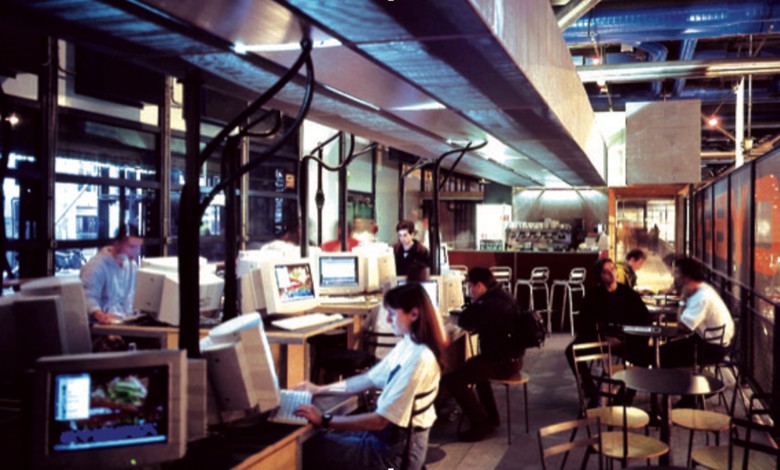
Retro voyage to Internet pioneering in Paris 1995
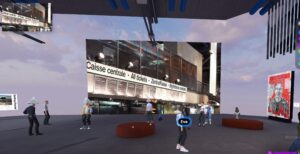
Back in 1995, I had the rare privilege to assist in the birth of the French Internet.
Jacques Chirac was in charge, and he realised that French proprietary technology called Minitel was not going to get Parisians tothe Information Superhighway (remember Al Gore?) that all other countries were busy building.
One late Friday in May 1995, we got a very special call. It was only a few years after the National Science Foundation, a US-based ‘Net Mother’ agency that managed the Internet, made a momentous decision to grow the network beyond military and academia. They allowed commercial traffic and opened the nodes to civilians like us. I was already using this magic new network in the UK, with our first Internet Café Cyberia London– hosting the first public access node for email and Web from the pioneering Internet Provider, Easynet.
But in France, it was Minitel or nothing.
So the call came, from no other but the then President of Centre Pompidou, Monsieur Francois Barre. Would you like to open Cyberia Café Paris in our Centre?
We jumped at the opportunity, hopped on the newly opened Eurostar train and rushed to Paris, with our architectural plans in big tubes under our arms. The process was not without challenges. The first designs were rejected by the then lead architect of Centre Pompidou, Mr Rogers (part of the famous Roger & Piano duo).
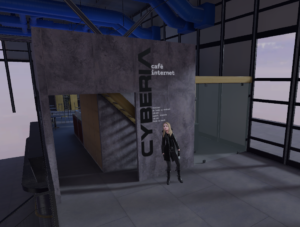
But we have seen it coming. Our secret weapon was Bernhard Blauel, young, charismatic German architect who defined the early venues where normal folks were invited to use computers and the Internet in public. His designs, featuring bold CYBERIA letters spray-painted on metal mesh just above the Ticket Centre and visible from miles away, won the day. Both President Barre and, finally, Mr Rogers accepted our futuristic proposals.
We opened on 29th Nov 1995 and spent the next few years creating a bridge for Parisian creatives from Minitel to the Internet. We helped many amazing musicians who wanted to share their music online. We often supported striking union workers as the strikes were held frequently in a location near us. But mostly, we offered a home to young French digital artists building new Web galleries to share new French digital art and games with the world.
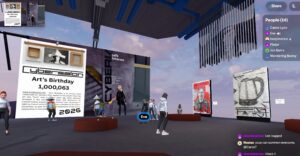
Fast forward to 2025. The world is moving to Virtual Reality, and the concept of Digital Twin for re-creating Internet Pioneering Nodes from 90ties is gaining ground. We join forces with Immersive Lab (PCM Creative) and Bernhard Blauel Architects to bring back the vibes from early Net scene from Paris. We launched it on 17th January 2026, to coincide with the Arts Birthday, celebrated in Europe on that day as a tribute to artists and their role in cultural progress.
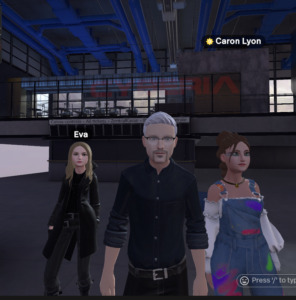
Cyberia Paris VR launch 17th January 2026
The night we launched the Digital Twin of Cyberia Paris, I felt a strange temporal vertigo. In my head, the two eras were briefly superimposed. The screens were glowing with a perfect reconstruction of that improbably digital salon inside the Centre Pompidou. The hum of CRT monitors was re-imagined in VR in soft LED blue light, the mezzanine floors rendered in pixels, the familiar bar counter hovering like a faint memory made tangible.
In my head, I could still hear the original modem chirps, which then gave way to proper broadband, courtesy of our Internet partner, Easynet, freshly set up in Paris.
I could smell the espresso, and feel the nervous electricity of the mid-1990s, when the future was something you could almost trip over.
Back then, France was still deeply entangled in Minitel, an elegant but stubborn proprietary system that made the country a digital pioneer, but later, paradoxically, an isolated digital island. The wider Internet (if not quite the Information Superhighway Al Gore promised us), was crashing onto global shores, but compatibility was political as much as technical.
The Internet, with new Open Source Web software released by Tim Berners-Lee in 1991, was moving very fast. Minitel was stuck on dead end of proprietary software. It was Monsieur Francois Barre, the formidable cultural president of the Centre Pompidou, who sensed that the moment demanded a symbolic breach of the wall. He wanted to expose the French creatives, digital and art communities to this unruly new networked world.
His invitation to the Cyberia Café team, Gene Tear, David Rowe, Keith Teare and me, plus our extended family with Bernhard Blauel and others, was not just about opening an Internet Café. It was about staging a cultural intervention. TCP/IP protocol was born in the USA, but the Web was a brainchild of European scientist and released by CERN, both highly respected in France, which made it acceptable in Paris.
It is easy to forget now, but Europe had only just given birth to the Web itself. Tim Berners-Lee released the World Wide Web to the public in August 1991, just three years before Cyberia Paris opened its doors. This was not an imported American product yet. It was seen as a European invention, raw, unfinished, full of optimism about openness and decentralisation. We weren’t renting space inside American corporate platforms. We run our own servers. Through partnerships with Easynet in the UK and France, we hosted our own data centres for musicians, gamers and artists. We controlled our own infrastructure, our own social media communities, our own digital destiny.
By early 1996, Cyberia London had already become an addictive, mesmeric hybrid of Salon, Café, Art Laboratory and a chaotic social experiment. Bringing that spirit to Paris meant building a ‘futuristic salon inside one of Europe’s most iconic modern buildings. Yet the irony was delicious, the very architect who had once scandalised Paris, now hesitated to allow another provocation. Mr Rogers, of Rogers & Piano duo, was hoping to discourage us as he did not want to ‘confuse’ the original architecture. The building in his mind, was already a manifesto. But as with all manifestos, they need occasional updating. Monsieur Chirac and Barre understood that. But to Mr Rogers, adding rows of glowing computers felt like cluttering a cathedral.
Enter Bernhard Blauel, Cyberia’s charismatic architect, whose persuasion skills were as important as his sketches. He framed the café not as an intrusion but as a continuation of the Pompidou’s radical DNA – a living, breathing, modem-beeping exhibit of networked culture. Our ‘project’ meetings stretched, espresso cups multiplied, and eventually, permission was granted. When the first computers were installed, it felt less like fitting furniture and more like wiring a nervous system.
The wider world mirrored our optimism. The Eurostar train had just begun its underwater dash between London and Paris, shrinking the Channel into a coffee break. We rode it often, carrying hardware, ideas and huge enthusiasm. In UK, a new Leader of the Opposition named Tony Blair was promising a more progressive future, while in France, President Jacques Chirac projected renewed European confidence.
Progressive politics were in vogue, and the ‘peace dividend’ of the post-Cold War era was transforming military budgets into new cultural ambitions. There was a sense, naïve perhaps but intoxicating, that digital networks could knit societies closer, that art and technology together might soften old borders and heal divisions.
Inside Cyberia Paris, Europe’s digital culture was taking shape in real time. We weren’t waiting for Silicon Valley templates. We had our own social media pages, our French, German, British digital artists, our own experimental games and net-native music scenes. Jamiroquai blasted through the speakers while designers like Tom Roope from AntiRom hacked HTML tables into visual poetry. Pioneering Net artists like Olia Lialina, Hannah Gal and William Latham were forging new aesthetic languages in cyberspace, long before “generative art” became a buzzword.
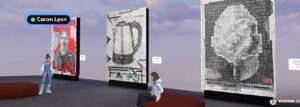
Meanwhile, across the Atlantic, millions were still logging into walled digital gardens like Prodigy or AOL, boxed into proprietary portals. In London and Paris, we were building open rooms instead of walled compounds. No closed-up Facebook or Instagram then, controlled by commercial and algorithm-crazy billionaires.
Cyberia Paris became a daily performance of that belief. Musicians tested early music distribution websites, women built their very own online galleries, students opened their first email accounts, journalists hovered over Mosaic or Netscape browsers like over a crystal ball.
Chats are split across languages and topics. Some days it felt like hosting a perpetual opening night. Other days, it felt like debugging the future with duct tape and patience.
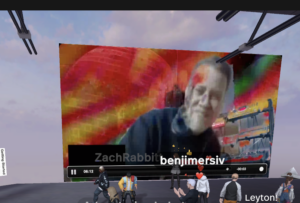
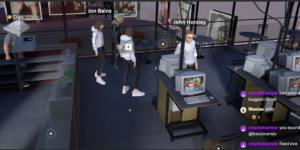
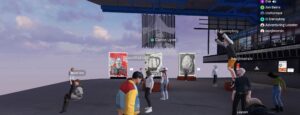
Fast forward to today, and the Digital Twin launch of Paris Cyberia Café in VR carries the same restless spirit, only now nostalgia is part of the interface. Dancing in VR through the virtual space, I watched younger visitors, our students and young artists explore Cyberia as an artefact, clicking on recreated terminals that display early web art and grainy photos of the 1995 opening night. For the kids, it’s history. For us, it’s muscle memory. One of the visitors commented, “It was like browsing through his Dad’s floppy disc collection up in the attic “. Another commented how lucky we were as a generation to have that moment of idealistic optimism.
What moved me most was how the Digital Twin of Centre Pompidou Cyberia doesn’t merely preserve the room, it preserves a mood. The optimism is encoded in the light, the openness in the layout, the improvisation in the imperfect details. It reminds us that tech is never just hardware and protocols. It is shaped by politics, architecture (thank you, Bernhard), friendships, late-night arguments and improbable alliances between a French cultural leader, Monsieur Barre, determined to open a window to the world, a sceptical Mr Rogers, the architect guarding his masterpiece, and a band of Internet idealists chasing a future that barely had a name.
Today, perhaps the most important lesson is this: Europe once led the digital imagination. We invented the Web, we built open networks. We created culturally rich online spaces rooted in art, diversity and digital chaotic experimentation. In reviving Cyberia as a Digital Twin, we are not merely commemorating the past. We are reminding ourselves that we can learn from those early pioneers and create new European digital spaces, true to our own culture, values and, most important of all, creative spirit.
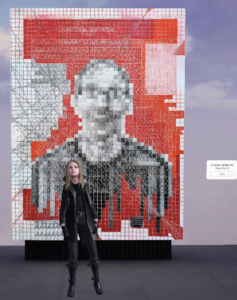
Standing there in VR, half in pixels, half in memory, I realised that Cyberia was never about access to the Internet in pre wi-fi and pre-mobile phone era. It was about access to possibility. And that invitation still stands.
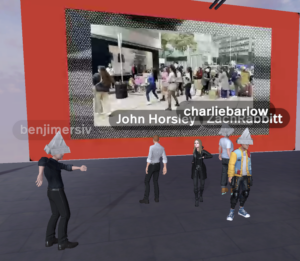
Thank you for the music performance contribution at the launch from John Horsley and Miss Naivety, and for digital art show by Zoe Camper (OG Cyberia and Easynet) and Halidonto.
Big thank you to Old Cyberians who made the built possible, Keith Teare, David Rowe, Wael El Azab, Zoe Camper and to Cybersalon.org digital creators Jon Bains and Ben Greenaway for help and guidance. Thank you to Charles Barlow and Renee Lei (FRSA Fellows) and Dan Stapleton for feedback. All notes will go to release Cyberia Paris 2.0
Credits to PCM Creative, Bernhard Blauel Architects and Cyberalon.org
