
How are things?
Write up by Irina Shtreis
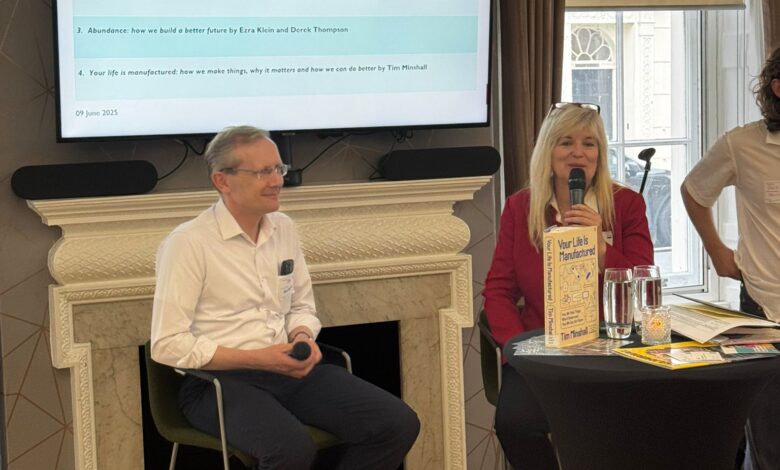
On 9 June, the Royal Society of Arts and London Fellows Meet Up hosted the launch of Your Life Is Manufactured, Tim Minshall’s latest book, which delves into the complexities of the invisible side of things—production.
In his book Language Of Things, published in 2009, Deyan Sudjic, formerly the director of the Design Museum in London, looked at design as a form of communication between an object and a consumer: “Our relationship with our possessions is never straightforward. It is a complex blend of the knowing and the innocent”. While the language of brands and specific outlines associated with them has a discernible effect, manufacturing is often not appreciated as an essential element. Yet, using the linguistics term, it’s the grammar of the tongue that things speak.
Similarly to Sudjic’s book, the latest work by Tim Minshall, Your Life Is Manufactured, advocates for consumerist awareness and conscious buying. Delving into the production cycle of simple objects, Minshall, whose scope of work lies within academic research in innovation and manufacturing at the University of Cambridge, takes his reader to the invisible side.
As the head of the Institute for Manufacturing (IfM at the University of Cambridge), the researcher has been following the principles of engaged scholarship. Originally introduced by American academic Andrew H. Van de Ven, the concept can be defined as participatory research with mutual benefits for theoreticians and industry workers. “For us, academic work is engaging with the real world”, explains Minshall. “If we want to understand the problem it might be research problems in manufacturing. We go and visit factories and talk to people who have a problem”.
Based on multiple visits and field trips to enterprises, interviews and secondary sources, Your Life Is Manufactured is comprehensive and revelatory. It instils curiosity and a sense of wonder in someone using day-to-day objects for their routine. Encouraging his reader to take a look at a generic roll of toilet paper, the writer then tells us its life story – from four phases of a tree production cycle to paper converted into plies (layers) forming a roll. Things like toilet paper, as Minshall points out, are taken for granted until the system is suddenly incapable of accommodating the needs of the masses in a situation of emergency. Take the consumerist frenzy that haunted the public subconscious during the first lockdown.
Yet, translating the academic language with its terminology, facts and figures for the wider audience was not the most straightforward task. “It’s very uncomfortable to be writing in a style that you haven’t been trained in”, admits Minshall. “It feels very different, it’s much more personal, much more light-hearted”. With the help of a storytelling trainer, the author created a narrative that is at times jaw-dropping and delicious (e.g. the dough preparation and baking process at Fitzbillies in Cambridge).
The book’s storytelling approach was inspired by a visit to a primary school where the researcher gave a talk about manufacturing for ten-year-olds. This experience gave him a new perspective and idea for the project. “The best way of learning something is having to explain it”, says Minshall. “Like Richard Feynman said, if you want to learn something, try and teach it to a nine-year-old child”. Similarly, the writer noticed that adults expressed their curiosity and asked as many questions as children. “What started as a children’s book project eventually became a book for grownups”, Minshall reveals to Eva Pascoe, event host and RSA Trustee.
Talking to London Fellows after the event, the author reflects on the learning process and discoveries while working on the book: “I was impressed to see that there is so much complexity in manufacturing of things very simple, like my example of the toilet rolls, a very simple product that has a very complex supply chain and lots of companies and lots of different places and things that are moved between them. If you then look at a car or an aircraft with millions of components that is not appreciated. What you are having is hundreds of different companies, all making different bits of an aircraft and all of these have to come together to build an aircraft literally”.
The event was co-sponsored by Cybersalon.org, a think-tank promoting digital inclusion
