
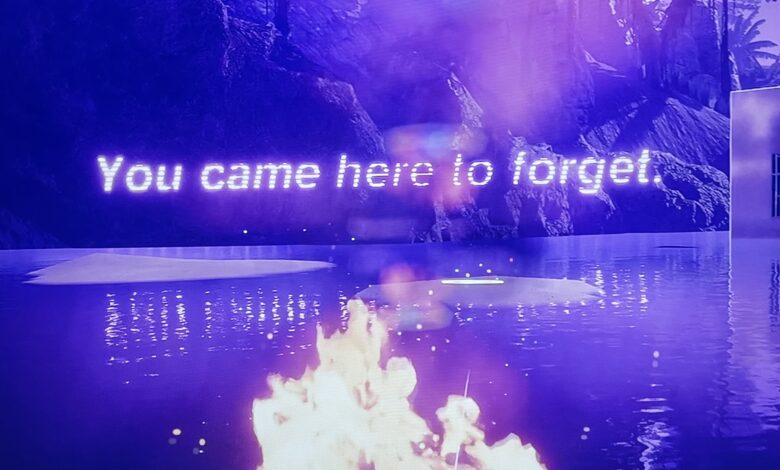
Forget like a Human : new digital art show by AreByte
How to Forget like a Human – review of “What is it like?” in WRO Digital Gallery (Wroclaw, Poland, Oct-Nov 2025) by touring AreByte Gallery (London- Camden) @arebyte @WROartCentre
The show ‘What is it Like?’, presented at WRO by AreByte artists from London, asked a deceptively simple question that touches the heart of both art and artificial intelligence: what does it mean to remember? If memory is the foundation of identity, then how does an entity such as AI, an entity without lived experience, can recall data but not actually live through events or participate in this deeply human domain?
The exhibition, held in WRO Digital Art Gallery and curated for AreByte by Helen Starr, brought together works by Anna Bunting, Katarzyna Krakowiak, Lawrence Lek, Damara Ingles, Choy Ka Fai and Kira Xonorica. Each artist approached memory through a different sensory and conceptual lens, creating a fable-like environment that blurred the boundaries between archive, colourful, baroque sensation and imagination.
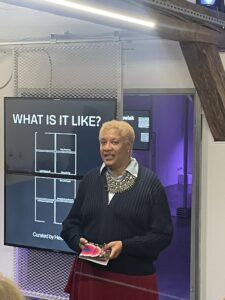
At the centre of the curatorial premise was the distinction between ‘semantic’ memory, which AI can store in text and retrieve, and ‘episodic’ memory, the personal recollection of lived and ‘experienced’ events. AI may know what a dreamy sunset is, may catalogue every description of one, but it does not ‘remember’ ever standing in the cooling light at dusk.
This absence framed the exhibition as a mediation on separation, the gulf between memory as an inventory for facts and memory as the subjective ground of being, of constituting a soul.
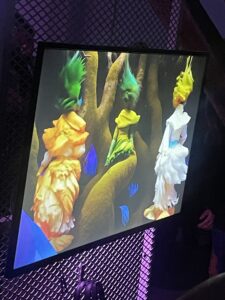
Anna Bunting’s VR dreamscapes placed the viewer within a floating sequence of alien environments that felt at once intimate and disembodied. Her delicate paintings suggest memory as a space perpetually under construction, a set of fragile spaces rearranged by time and emotion.
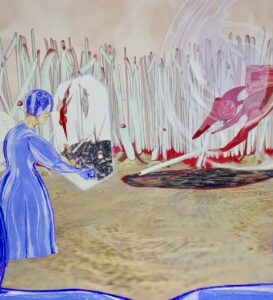
Bunting’s use of VR mirrored the way AI models ‘reconstruct’ memory not be reliving but by reassembling fragments. Entering her space travel landscapes is like entering the neural net of a remembering machine, ordered, but somewhat strangely devoid of the warmth of first-hand experience. Based on Naomi Mitichson ‘Memoirs of a Spacewoman’, this work explores memories of Mary, the space traveller, exploring new world beyond her galaxy. I couldn’t help but wonder what Valentina Tereshkova, the first woman in space, would have made of Anna’s piece. Her pioneering space flight took place only a year after Naomi’s book was published. In fact, Mitichison visited Moscow and was knew about the pioneering Russian space program. Those memories of both imaginary and real female astronauts are intertwined in Anna’s piece.
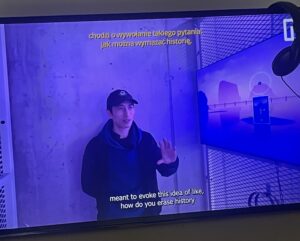
Lawrence Lek, by contrast, grounded his contribution in place. His installation explored the memory of a lost city of Nepenthe, its grandiose, ghostly, temple-like architecture, and the psychic residue of the space, with ruins revealed accidentally by a tornado after many centuries of being buried under layers of sand. Lek’s digital, urban environment asked, if we lose the memory of place, do we also lose our grounding in history? For AI, spaces exist as coordinates, tokens, embeddings and blueprints. Lek’s work highlighted that divergence, underscoring how memory is not only about what is stored, but also about the meanings attached to where we have been.
More meditations on the erosion of memory appear in Damara Ingles’ poignant piece about her beautiful, sexy and vibrant mother, whose memory is fading away with Alzheimer’s disease.
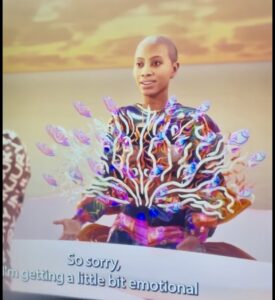
This work is less about accumulation than about disappearance, about the slow fading of recognition, the breaking apart of coherence. In this context, AI’s semantic memory appeared almost cruelly permanent, indifferent to the fragility that defines human recollection. Yet Ingles’ work also suggested that loss is part of what makes memory so precious. Without the threat of forgetting, remembering has no urgency. As I nurse my own mother through her unrelenting dementia, the slow but inevitable process of breakdown of identity is something no AI records, images of videos gathered can mitigate.
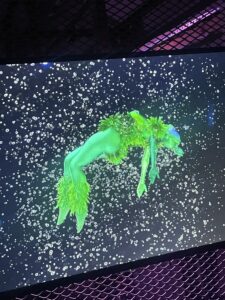
In a more kinetic, body-memory piece, Kira Xonorica expanded the frame to the body itself, exploring the memory of dance and the notion of muscular patterns. In her work, movement, dance, tradition becomes archive, steps repeated until they inscribe themselves on the flesh. For AI, ‘muscle memory’ exists only as an algorithmic optimisation. For humans, it is the resonance of repetition, the way choreography becomes second nature. Xonorica’s work invited visitors to imagine what it might mean for AI to develop something analogous, not just recognising dance patterns of motion, but inhabiting them, living through dance storytelling.
Taken together, the exhibition ultimately offers not a lament over AI’s lack of subjective memory, but an invitation to think differently about remembering as well as forgetting. By juxtaposing human fragility and machine permanence, the show revealed how each form of memory, both lived and semantic, illuminates the other. The human capacity to forget, to reshape the past, to embed it in body and place, becomes all the more precious when contrasted with AI’s crystalline recall. Conversely, AI’s vast semantic web reminds us that memory can also be collective, distributed, and external to the self.
As we left the show in Wroclaw, it left us with a paradox. AI can’t yet ‘remember’ as we do, but it can help us see our memory anew through a new lens. In the interplay of Bunting’s space-scapes, Lek’s forgotten cities, Ingles’ losses of a parent, and Xonorica’s retrieved dance movements, the exhibition suggested that AI might one day not only catalogue our pasts but also open doors to perceiving the experience of others in an intimate, soulful way. There is still so much to learn about how AI might offer more than just semantic memory, and “What is it Like?” pointed to the possibilities that, through art, we may glimpse the world of others, even across the boundary between human and machine.
Arts Council, the British Council, WRO Digital Gallery and AreByte Gallery sponsored the exhibition.
